OnlyFans Agency Red Flags: 12 Signs to Walk Away
OnlyFans agency red flags that should end the conversation: income promises, upfront fees, password grabs, exit fines, and what to do if you already signed.
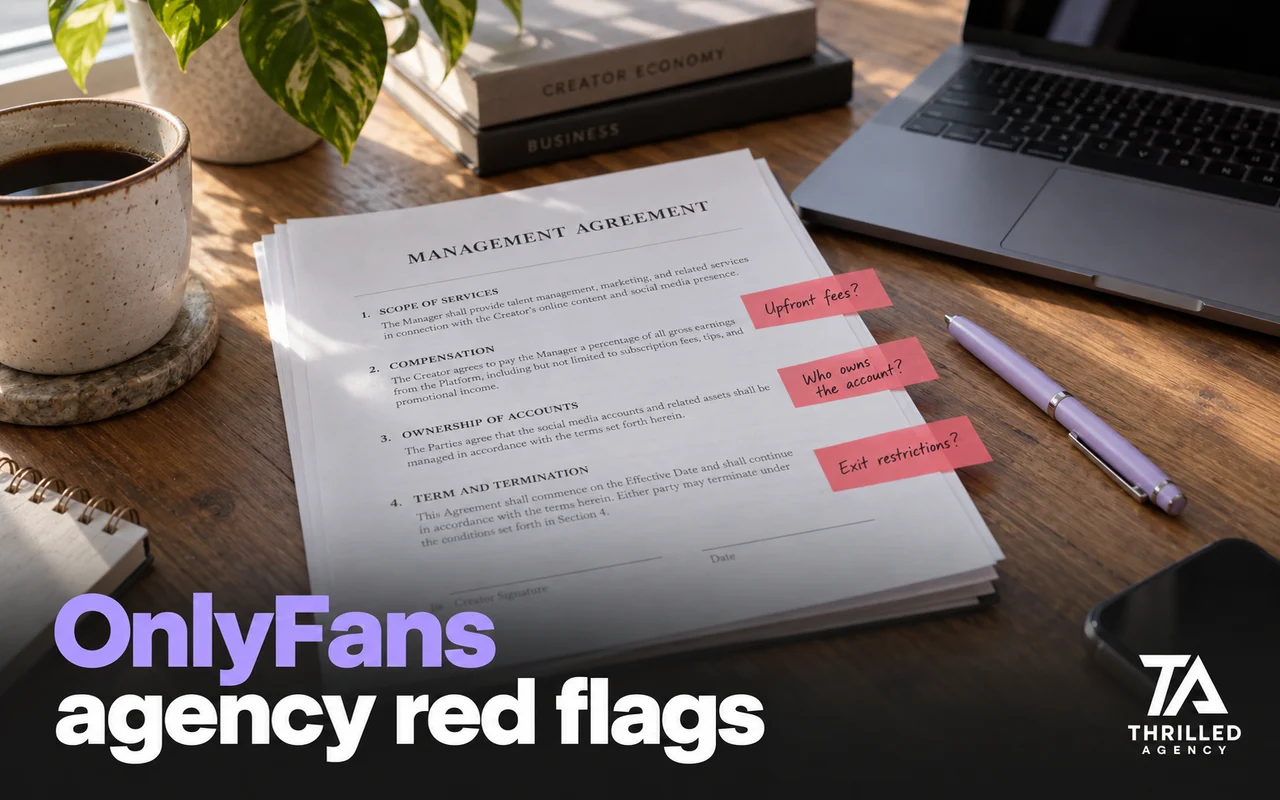
Direct answer: the OnlyFans agency red flags that matter most all come back to who carries the risk. Walk away from any agency that promises a specific income, charges before it earns, wants your account's email or bank details in its name, asks for your password in a chat, fines you for leaving, or pressures you to sign today. Legitimate management agencies earn a percentage of results, so your risk is shared. Predatory ones shift all of it onto you.
Below are the twelve signs we would never ignore, grouped by where they hit you: your money, your account, and the way the deal is sold. Several of them are documented in a June 2026 BBC investigation into how some OnlyFans managers treat the creators they sign.
OnlyFans agency red flags about money
1. They promise a specific income
"$5k a month or your money back" is not a business model; it is a funnel for collecting fees. Nobody can promise revenue on an account they have not run yet, and honest teams say so. The FTC's advice on business offers and coaching programs puts it plainly: an offer that promises you income, large returns or a "proven system" is likely a scam.
2. They charge before they earn
Onboarding fees, setup fees, "marketing budgets" payable before any work happens. Once an agency is paid regardless of the outcome, you are no longer the client. You are the product.
3. The split is on gross, or it keeps growing
A split calculated before OnlyFans' 20% fee is a bigger share of your money than it sounds, and open-ended "expenses" for tools, ads or "processing" can add more on top. Ask for one number, as a share of net, with every other deduction listed and capped. The arithmetic is in OnlyFans agency commission explained.
4. Your payouts route through them
Earnings should land in your bank account, and you pay the agency its share. One creator told the BBC their manager had changed the bank details on the account so the money went directly to the manager. If an agency offers to "handle payouts" for you, the answer is no.
Red flags about your account and content
5. They want the account in their name
Some contracts move your login email, or even your payout details, to the agency. If you leave, you lose the page you built. The BBC saw a contract that gave a manager the ability to change the email address on a creator's account. A real agency works inside your account with documented access; you keep the email, the bank details and the final say.
6. They ask for your password in a chat
"Just send us the login" tells you how they will treat the rest of your security. A professional team uses named access for named people and wants two-step verification switched on, not off. CISA, the US cybersecurity agency, notes that people who enable multi-factor authentication are significantly less likely to get hacked. Another told the BBC their manager had changed the password to lock them out.
7. The contract claims your content
Read the content clause for ownership language. The agency needs a limited right to use your content to run and promote your page while you work together, and that right should end when the contract does. Any clause that lets them keep or reuse your content after you leave is serious enough to end the conversation.
8. They push past your boundaries
Your boundaries are yours to set, in writing, before you sign. An agency that pressures you toward content you said you will not make, or writes fan-request deadlines into the contract, is working for its own numbers. The BBC saw a contract that required a creator to fulfill subscribers' content requests within 24 hours.
Red flags in how the deal is sold
9. Cold DMs promising the world
Serious agencies vet creators before signing them, because their income depends on picking accounts they can actually grow. If an agency mass-DMs everyone with the same pitch, their business is volume of signups, not growth of accounts.
10. Pressure to decide today
"Spots close tonight" is a sales tactic. The same FTC guidance lists it among the signs of a scam: pressure to get involved now or risk losing out. Any team worth joining will let you take the contract to a lawyer, ask questions, and sleep on it.
11. Exit fines and long lock-ins
Twelve-month exclusivity, fees for leaving early, automatic renewals with long notice windows. The BBC found contracts that fine creators who try to leave early. Agencies confident in their results do not need to trap you. Look for month-to-month terms or a notice period measured in weeks, and a written description of what happens when you leave.
12. Proof you cannot check
No website, no case studies, a Telegram handle for support, and dashboard screenshots anyone could fake. Anonymized case studies are normal, because many creators want privacy, but an agency should still be able to explain who will work on your account, what they changed for others and over what period, and put the terms in writing. If none of that can be checked, neither can the agency.
Things that are not red flags
- A revenue share of real size. A full team costs money. A high split is a question to ask, not proof of a scam; the answer is in what it buys and whether it is calculated on net.
- Asking for access. Nobody can chat or schedule for you without it. The question is how access is given: documented, limited to named people, and reversible.
- Being told "not yet". An agency that says your page is not ready for management is protecting both of you.
- Anonymized results. First name, initial and country is how careful agencies publish results.
If you have already signed a bad agreement
- Secure the account. Check that the email and bank details on it are yours, change the password, and turn on two-step verification.
- Keep your own records. Download your earnings statements and save the contract and your messages with the agency.
- Read the exit terms. Find the notice period and any termination clause before you act.
- Talk to a lawyer before you stop paying or walk away from the contract. Exit terms vary, and this is not something to guess at.
- Treat threats as a police matter. If anyone threatens you, it is no longer a contract dispute.
Do not expect the platform to settle it for you. In its statement to the BBC, OnlyFans said its relationship is with creators and fans, that it is not connected with and does not endorse any third parties including management agencies, and that it cannot review contracts creators enter into outside the platform. What good offboarding should look like is covered in what happens when you hire an OnlyFans manager.
One rule catches almost every scam: if the agency makes money before you do, walk away.
Vetting us
Vetting Thrilled is easy. We charge nothing upfront, work on revenue share only, have no lock-in contracts, and you stay the owner of the account, the payouts and the content. The audit that starts the conversation is free, and if we think you do not need an agency yet, it says so. Bring the questions to ask an OnlyFans agency and use them on us, then apply for a free audit. Demand the same from anyone else you talk to.
Frequently asked questions
Are OnlyFans agencies a scam?
Not all of them, but enough are that you should vet every one. The legitimate ones earn only when you earn, leave the account in your name, and let you leave without fines. Anything else deserves a hard look.
Should I give an OnlyFans agency my password?
Not in a chat message, and never in a way that lets them change your email or bank details. A professional team uses documented, named access with two-step verification on, and you can revoke it at any time.
Can an agency take my OnlyFans account?
It should not be able to. Keep the login email and the bank details in your own name and you keep control. The accounts creators lose are usually the ones where those details were handed over.
Is a 50% commission a red flag?
Not on its own. The BBC found 50% to be a common split. It becomes a red flag when it is on gross, comes with upfront fees or exit fines, or buys a manager who barely touches the account.
How do I leave an OnlyFans agency?
Follow the notice period in your contract, then make sure access is revoked, the password is changed and fan notes are handed back. If the agency disputes the exit or holds anything back, talk to a lawyer.
Do real agencies recruit creators through DMs?
Some reach out, but a copy-paste pitch sent to everyone is a warning sign. An agency that has actually looked at your page can say specifically what it would change.
The team managing live OnlyFans accounts at Thrilled Agency — chatters, strategists, and marketers writing about the work they do daily. Our editorial standards →
Let our team handle the business of you.
Creator-focused management. We don't take more clients than we can give white-glove attention.