OnlyFans Agency Commission: What's Fair and What's a Rip-Off
OnlyFans agency commission explained: common splits, gross vs net, what the percentage should buy you, and the fee structures to walk away from.
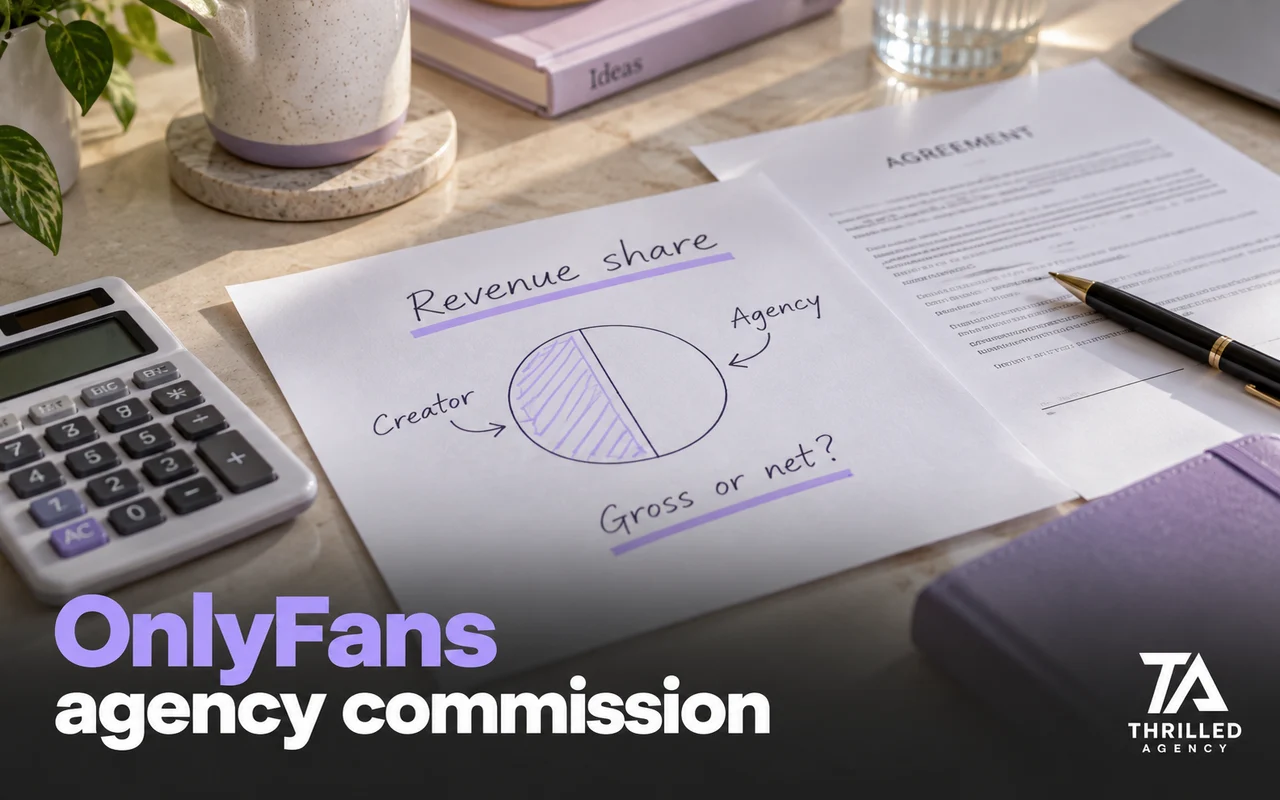
Direct answer: an OnlyFans agency commission is a share of what your account earns, normally taken from your net after OnlyFans keeps its 20%. There is no standard rate, and the most common split reported is half. Whether a split is fair depends on two things, not the number alone: what it buys, and whether it is charged on net or gross. A higher split with a full team can leave you with more dollars than a low split with a part-time manager, and a low split with the wrong clauses can cost you the most.
We work on revenue share ourselves, so this is the part of the contract we think about most. Below: what agencies charge, how gross versus net changes the real percentage, what each kind of split should buy, and the structures that cost you more than the headline number suggests.
OnlyFans agency commission: what agencies charge
There is no public price list across the industry. The best independent picture is a June 2026 BBC investigation that reviewed contracts shared by creators. It found managers commonly taking 50% of creators' pre-tax earnings, with some contracts going as high as 70%. One contract it saw took that 50% after OnlyFans had already taken its own cut. Many of those contracts also demanded full access to account logins and fined creators who tried to leave early.
Lower splits exist, usually for lighter services: chat-only coverage, consulting, or promotion without the inbox. Higher ones exist too, usually attached to contracts you should not sign. On its own the percentage tells you almost nothing until you know what it covers and what it is calculated on.
Gross vs net: the clause that changes the real percentage
OnlyFans' terms of service set its fee at 20% of each fan payment, deducted before anything reaches your balance. What is left is your net. An agency's split should be calculated on that net. If it is calculated on gross, the agency's real share of the money you actually received is higher than the contract says.
Say fans pay $10,000 in a month. OnlyFans keeps $2,000 and credits you $8,000.
- 50% of net: the agency takes $4,000 and you keep $4,000.
- 50% of gross: the agency takes $5,000, which is 62.5% of what you received, and you keep $3,000.
Same number in the contract, $1,000 difference in your bank. Always ask which base the split uses, and get the answer in writing.
What the percentage should include
A split is a price, and a price should match the work. For a full management share you should expect everything: chatting around the clock, a real content calendar, daily promotion, leak protection, and a named person you can reach. A lighter share usually buys consulting plus some chatting hours, or promotion without the inbox. That is fine, as long as it is priced like what it is.
Whatever the level, you should get reporting on a schedule, not on request: revenue, fans, and what is working. If an agency asks for a full-service split, ask it to name who does each job on your account and what hours the chat team covers. Vague answers mean you would be paying for a package rather than a team.
Fee structures that are red flags
- Upfront or monthly flat fees. The agency gets paid whether you grow or not, so its incentive ends the day you pay. The FTC makes the same point about job hunting: its job scams guidance notes that honest placement firms do not typically charge a fee to job candidates.
- Commission on gross instead of net. See the example above: the real percentage is higher than advertised.
- Long lock-ins with exit fines. Twelve-month exclusive terms with cancellation fees mean the agency keeps you with a contract, not with results.
- Open-ended "expenses". Deductions for tools, ads or "processing" that are not listed and capped in writing can quietly add to the real split.
- Payouts routed through the agency. Your earnings should land in your own bank account, and you pay the agency its share. One creator told the BBC their manager had changed the bank details on the account so the money went straight to the manager.
For the non-financial warning signs, from password grabs to pressure to sign today, see OnlyFans agency red flags.
Is a higher split ever the better deal?
Frequently, yes. The split percentage is the wrong number to optimize. The right number is your monthly payout in dollars. Keeping 60% of a $6,000 account beats keeping 80% of a $2,500 one.
To compare two offers, convert both into dollars. Take your average monthly net over the last three months, ask each agency what it thinks the account can realistically reach and on what timeline, and multiply by the share you keep. Say your page nets $2,500 a month on its own:
- Agency A takes 20% and offers part-time chatting. If that lifts the account to $3,000, you keep $2,400, which is less than you make alone.
- Agency B takes 40% and runs the full operation. If that lifts the account to $6,000, you keep $3,600.
These are made-up numbers to show the math, not a forecast. Agency B only wins if it actually delivers, so ask how it plans to, specifically, and what happens if it does not. Judge agencies by what they will add, not by what they take. The full break-even math is in is an OnlyFans agency worth it.
You don't pay an agency a percentage. You pay them the difference between what your account earns with them and without them. Make sure that number is positive.
Contract terms to read before you sign
- The split and its base. One number, stated as a share of net earnings, with every other deduction listed.
- Termination. A notice period measured in weeks, no fines, and what happens to access, credentials and fan notes when you leave.
- Content ownership. OnlyFans' terms have creators confirm that they own their content or hold the rights to post it. Nothing in an agency contract should transfer that ownership; the agency needs only a limited right to use your content while you work together, ending when the contract does.
- Account access. Documented access for named people, with the email and the bank details on the account staying yours.
- Exclusivity. Reasonable for the account they run while they run it; unreasonable if it follows you after you leave.
Have a lawyer read anything you are unsure about. It is a business contract, and an hour of professional time costs far less than a bad clause. The rest of the checklist, from who chats with your fans to how you leave, is in 15 questions to ask an OnlyFans agency before signing.
How we charge at Thrilled
Revenue share only, with no upfront fees, ever, and no monthly fee. There are no lock-in contracts: leave any time, no penalties. You keep the account, the payouts and the content. If an agency is not the right move for your page yet, the audit will say so. Apply for a free audit and we will walk you through the numbers for your account before anything is signed.
Frequently asked questions
What is a normal OnlyFans agency commission?
There is no standard one. The BBC's 2026 investigation found 50% of pre-tax earnings to be common and saw contracts as high as 70%; lighter services usually cost less. Compare offers in dollars you keep, not in percentages.
Is the agency's commission taken before or after OnlyFans' 20%?
After, in a fair contract. The split should be calculated on your net earnings, what is left once OnlyFans has taken its fee. A split on gross is a bigger share than it looks.
Is a 50% split a rip-off?
Not automatically. For a full team running chatting, content, promotion and protection it can be fair, if the account grows enough that you keep more dollars than before. For a manager who checks in twice a week, it is too much.
Does OnlyFans take a commission too?
Yes. OnlyFans keeps 20% of every fan payment, subscriptions, tips and PPV alike, and the fee is not negotiable. Any agency share comes out of the 80% you keep.
Who pays whom: do I pay the agency or does it pay me?
You pay the agency. Payouts should always land in your own bank account, and the agency invoices you for its share. An agency that collects your earnings and pays you out is a red flag.
Can I negotiate an agency's commission?
You can always ask. What is usually worth more than a few points off the percentage is the base (net, not gross), a clean exit with no fines, and a written list of what the split includes.
The team managing live OnlyFans accounts at Thrilled Agency — chatters, strategists, and marketers writing about the work they do daily. Our editorial standards →
Let our team handle the business of you.
Creator-focused management. We don't take more clients than we can give white-glove attention.