OnlyFans Agency vs. DIY: Which Earns More for You?
OnlyFans agency vs DIY compared on hours, money and control: when running it yourself wins, when a team out-earns its cut, and the hybrid in between.
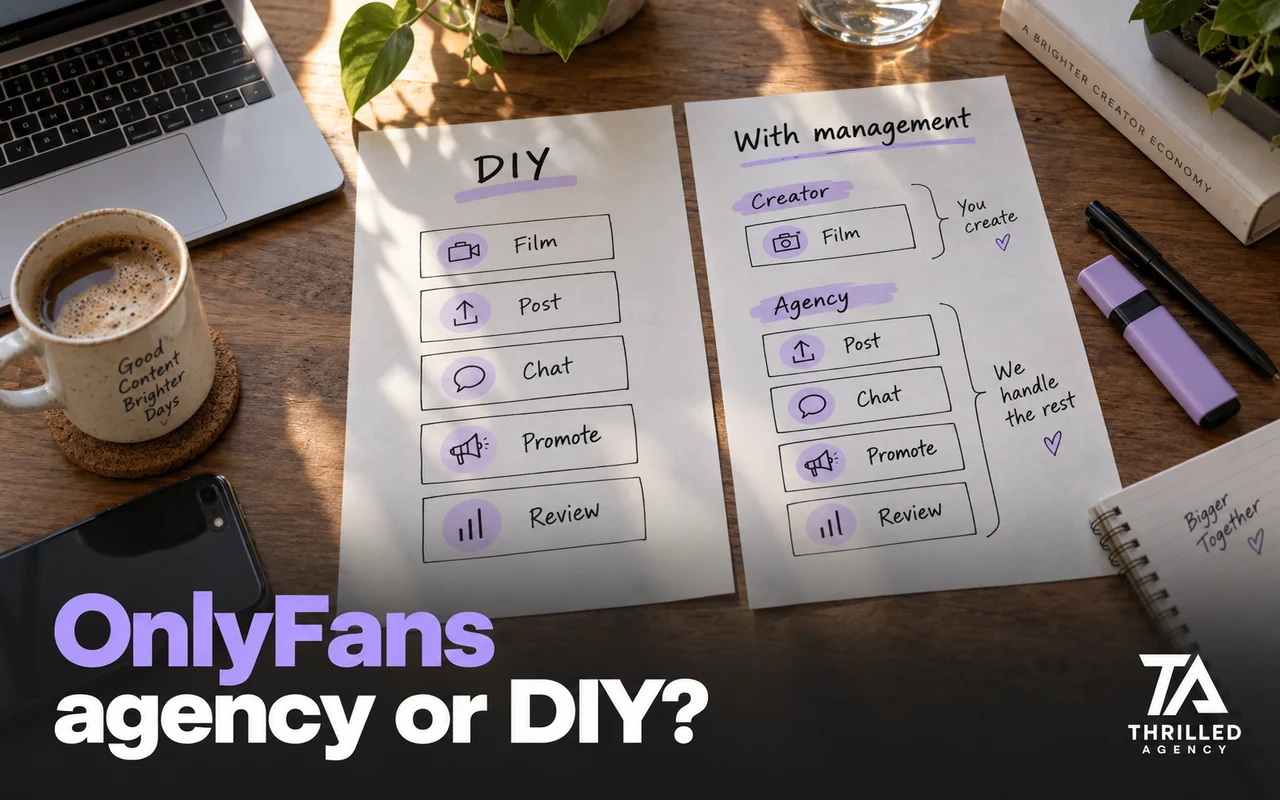
Direct answer: in the OnlyFans agency vs DIY choice, self-managed creators keep 100% of a smaller number and managed creators keep a share of a bigger one. Which is larger in dollars depends on how much unworked opportunity your account has, and the biggest variable is the DMs. DIY usually wins for a small account run by someone with spare time and business skills. An agency usually wins once the inbox, the promotion and the content no longer fit into one person's day.
Here is the comparison without the sales pitch, from a team that also tells creators when they do not need one: what each route really costs, where each one wins, the hybrid options in between, and a one-week test to decide.
What DIY really costs
Running an OnlyFans properly is at least three jobs: creating content, marketing it, and chatting with fans. Chatting alone is the revenue engine of the platform, and it rewards response speed and around-the-clock availability that one person cannot physically provide. When Vice reported on agency chat teams in 2023, one agency founder told them creators can make 50 to 60 percent of their earnings through messaging.
Every hour you spend in the DMs is an hour not spent creating, and the reverse. That trade-off is the real cost of DIY: not effort, but coverage. Sophia R., United Kingdom, one of the creators whose results we publish, describes where she started: "I used to spend 8 hours a day on DMs, posting, and promo."
What DIY gets right
- You keep everything after the platform fee. OnlyFans' terms of service set its fee at 20% of each fan payment. Running it yourself, the other 80% is yours.
- Full control. Your voice, your prices, your pace, with nobody else in your inbox.
- You learn the business. That knowledge stays useful even if you hire help later, because you will know what good looks like and when a team is coasting.
- No contract risk. A bad agency can cost you more than a slow month. DIY has no exit clause to worry about.
What an agency really costs
The split, plus some loss of direct control. Splits vary; a June 2026 BBC investigation found managers commonly taking 50% of creators' pre-tax earnings, with some contracts going as high as 70%. On top of the split, you will delegate your fan conversations to trained chatters and your posting schedule to a strategist, and spend real hours in the first weeks briefing the team on your voice and your limits.
A good agency makes this feel like relief; a bad one makes it feel like losing your page. The difference usually shows in the contract before it shows in the account, so read our list of OnlyFans agency red flags before signing anything. Whichever way you go, OnlyFans' terms are clear that someone else helping to run your account does not change your legal responsibility for it.
OnlyFans agency vs DIY, side by side
- Take-home share: DIY keeps everything after the platform fee. An agency leaves you what remains after its split.
- Chat coverage: DIY covers the hours you are awake and free. A full-service agency covers them around the clock.
- Promotion: DIY happens when you have energy left. An agency runs it daily and tracks subscribers per source.
- Control: DIY is total. With an agency it is shared, with your boundaries in writing.
- Risk: DIY risks your time and energy. An agency adds contract risk, so read the contract.
- Your hours: DIY takes all of them. With an agency, most of your time goes back to content.
Which one wins for your account
- Small account, strong business skills, spare time: DIY wins. Learn the systems yourself and keep everything.
- Growing account, DMs overflowing, content suffering: an agency usually wins, because unanswered messages are the most expensive leak on the platform.
- Plateaued account: it depends why. If it is a traffic problem, an agency's promotion systems help. If it is a niche or content problem, fix that first; a split will not.
- Brand-new creator: either works, but structure from day one compounds. How fans are treated in their first days decides whether they renew, and habits set early are hard to undo later.
Put numbers on it. Say your page nets $1,500 a month and you spend most evenings in the DMs. At a 50% split, a team has to take the account to $3,000 just for you to stand still in dollars. If your inbox is already answered within the hour and you promote every day, that is a hard target. If fans wait a day for a reply and you have not promoted in weeks, there is room. We run the full break-even math at every split in is an OnlyFans agency worth it.
The hybrid nobody mentions
Management is not all-or-nothing. Some creators outsource only chatting and keep promotion; some outsource promotion and keep the inbox. If an agency insists on all-inclusive control from day one but cannot explain why each piece is needed for your account specifically, that's a packaging decision, not a strategy.
- Chat-only help. A chat team runs the inbox while you keep content and promotion. It fits creators with steady traffic and more messages than hours.
- Promotion-only help. Someone runs your traffic channels while you keep the fans. It fits creators who convert well but cannot find the time to promote daily.
- Hiring a chatter yourself. Cheaper on paper, but you become the manager: you write the voice guide, cover the gaps when they are offline, and check the quality of every conversation.
How to decide in one week
- Count what you missed. Each morning, count the messages that arrived while you slept and multiply by your average PPV price.
- Track your hours. Log a week of time on content, DMs, promotion and admin.
- Run the break-even. At the split you are offered, work out how much the account has to grow before you are ahead.
- Get one audit. Ask an agency what it would change on your page. If the answer is specific, you have something to compare; if it is generic, you have your answer.
If you do test an agency, know what the first months should look like so you can judge it fairly; the realistic pace is in how long an OnlyFans agency takes to show results.
Keep 100% of what you can grow alone, or a share of what a team can grow with you. The right answer is just math plus honesty about your own hours.
How we handle the choice
At Thrilled every managed account gets a dedicated manager, a chat team, a content lead and a growth specialist, on revenue share only, with no upfront fees, ever, and no lock-in contracts. That only makes sense once time is the thing holding your page back. If you want the numbers for your specific page, our free audit shows what we would change and the growth we think is realistic, and if DIY is genuinely your better path, we'll say exactly that.
Frequently asked questions
Can you run OnlyFans without an agency?
Yes. An agency is optional, and a creator with time and business skills can run every part of the page alone. The question is whether your hours stretch to content, DMs, promotion and admin at once.
Is an OnlyFans agency better than doing it yourself?
Only if it adds more than it takes. If the managed account grows by more than the split costs you, the agency wins in dollars. If it does not, DIY does, whatever the pitch says.
How much time does running OnlyFans yourself take?
More than most creators expect. Content, DMs, promotion and admin are separate jobs, and once you pass a few hundred active fans, chatting alone is a full-time job.
Should I hire a chatter or an agency?
It depends on what is missing. If only the inbox is falling behind, a chatter or a chat team can be enough. If promotion, content planning and the inbox are all slipping, a full agency covers more of the gap.
Can I go back to DIY after working with an agency?
Yes, if the contract lets you leave cleanly. Check the notice period and exit terms before you sign, and make sure the account, email, bank details and fan notes stay yours.
The team managing live OnlyFans accounts at Thrilled Agency — chatters, strategists, and marketers writing about the work they do daily. Our editorial standards →
Let our team handle the business of you.
Creator-focused management. We don't take more clients than we can give white-glove attention.